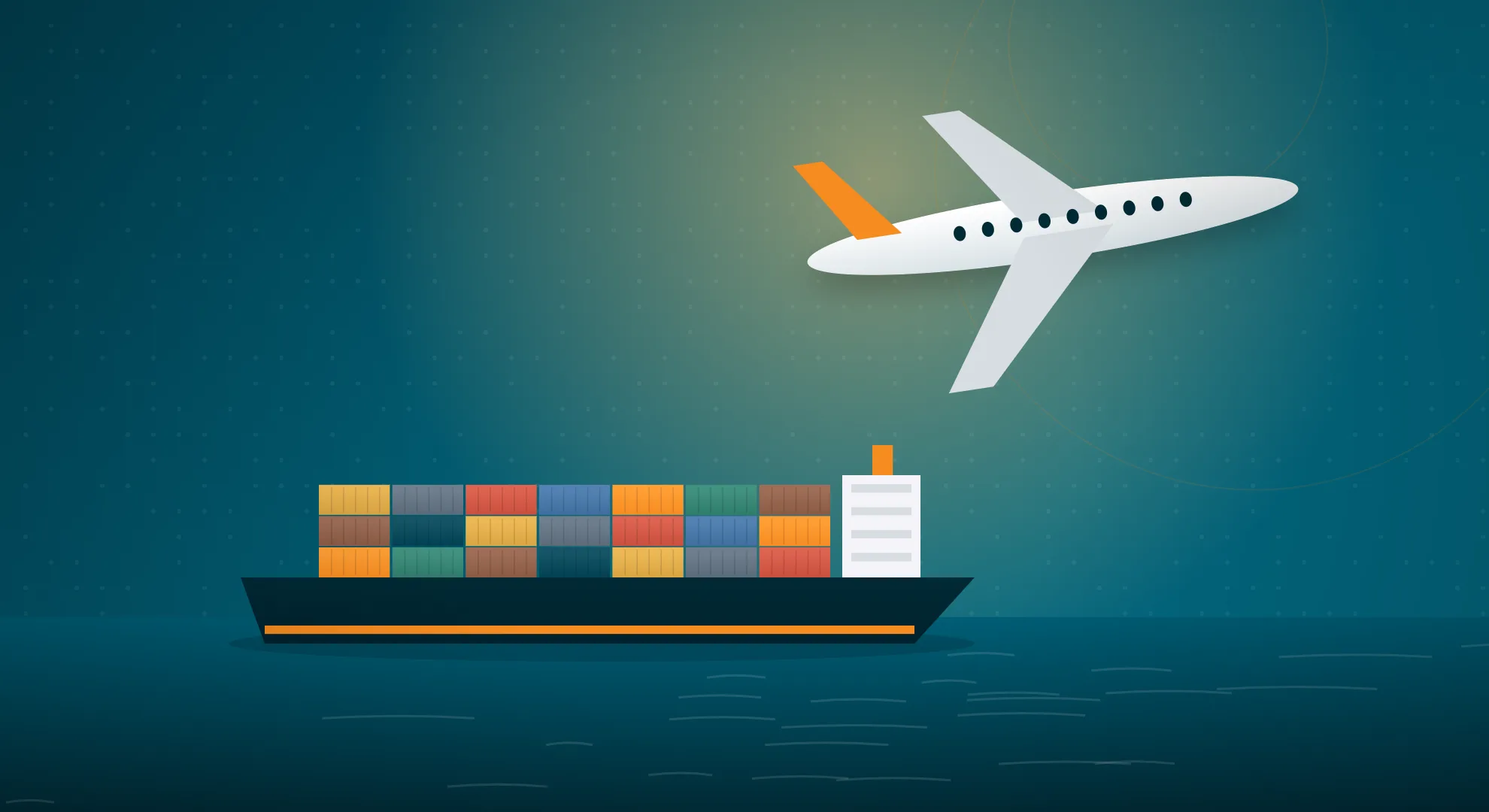
Every importer sourcing from India eventually faces the same question: should this shipment go by sea or by air? The answer affects landed cost, cash flow, stock availability and even customer satisfaction. Sea freight is usually far cheaper per kilogram, while air freight is much faster. But the right choice depends on more than just price and speed.
This guide compares sea freight vs air freight from India, explains how each is priced and helps you decide which mode suits different products and situations.
How Sea Freight Works
Sea freight moves goods in shipping containers, either as a full container load (FCL) or shared less-than-container load (LCL), or as bulk or break-bulk cargo for commodities. Goods are typically cleared by Indian Customs at a port or inland container depot, loaded onto a vessel and shipped to the destination port, often via transhipment hubs. At destination, the container is discharged, cleared by customs and delivered by road or rail.
Sea freight is priced per container for FCL and per cubic metre or tonne for LCL, plus origin and destination charges. Read our detailed comparison of FCL vs LCL shipping from India for more on container options.
How Air Freight Works
Air freight moves goods on cargo aircraft or in the cargo holds of passenger flights. Shipments are delivered to an airline or air cargo terminal, cleared by customs, flown to the destination airport and released after import clearance. Many air shipments are consolidated by forwarders to obtain better rates.
Air freight is priced per kilogram of chargeable weight, which is the greater of the actual gross weight and the volumetric weight. Volumetric weight reflects how much space the cargo occupies; a commonly used formula divides the volume in cubic centimetres by 6,000. This is why light but bulky goods, such as cushions or handicrafts, can be expensive to fly.
Sea Freight vs Air Freight: Key Differences
| Factor | Sea freight | Air freight |
|---|---|---|
| Cost per kg | Low | Much higher |
| Transit time | Weeks, depending on route | Days |
| Suitable cargo | Heavy, bulky, high-volume goods | Urgent, high-value, low-volume goods |
| Capacity | Very large | Limited by aircraft space and weight |
| Schedule reliability | Can be affected by port congestion and transhipment | Generally more predictable |
| Handling risk | Low for sealed FCL | Lower transit time, less exposure to humidity |
| Environmental footprint | Lower emissions per tonne-km | Higher emissions per tonne-km |
When Sea Freight Is the Better Choice
- Heavy or dense goods: Rice, grains, fasteners, stone and metal products are almost always shipped by sea.
- Large regular orders: Retail programmes and wholesale replenishment benefit from low unit freight costs.
- Price-sensitive products: Where freight would form a large share of product value.
- Planned inventory: When orders are placed far enough ahead to absorb longer transit.
When Air Freight Is the Better Choice
- Urgent replenishment: When stock-outs would cost more than the freight premium.
- Samples and trial orders: Speed helps approve products and launch faster.
- High-value, low-volume goods: Freight is a smaller share of product value.
- Seasonal or time-sensitive goods: Festive collections or event deadlines.
- Short shelf-life products: Some food items benefit from shorter transit, subject to regulations.
Hidden Costs to Consider
Comparing only the freight rate can be misleading. Consider the total landed cost:
- Inventory carrying cost: Longer sea transit means capital is tied up in goods for longer.
- Safety stock: Slower and less predictable supply chains require higher buffer stock.
- Origin and destination charges: Terminal handling, documentation, customs brokerage and delivery.
- Packing differences: Air cargo may need lighter packing to control chargeable weight, while sea cargo needs moisture protection.
- Insurance: Premiums depend on value, route and mode.
- Surcharges: Fuel, peak season and security surcharges fluctuate.
Hybrid Options: Sea-Air and Split Shipments
Some buyers combine both modes:
- Split shipments: Send a small part of the order by air to launch quickly, and the bulk by sea.
- Sea-air services: Cargo moves by sea to a hub and then by air to the final destination, offering a middle ground in cost and speed on some routes.
- Express courier: For documents, samples and very small parcels, courier services provide door-to-door speed.
Practical Decision Framework
- Calculate the chargeable weight for air and the volume for sea.
- Request quotes for both modes, including all origin and destination charges.
- Estimate the cost of delay: lost sales, penalties or idle production.
- Compare freight as a percentage of product value.
- Consider product sensitivity to humidity, temperature and handling.
- Choose the mode, or combination, with the best total outcome.
Packing Tips by Mode
For sea freight: Use strong cartons, pallets that comply with ISPM 15 if wooden, moisture barriers and desiccants for humidity-sensitive goods, and secure loading to prevent shifting.
For air freight: Minimise empty space to reduce volumetric weight, use lightweight but protective materials, and follow airline rules for any restricted items.
Documents for Each Mode
Sea shipments use a bill of lading; air shipments use an airway bill. Other documents, such as the commercial invoice, packing list, certificate of origin and regulatory certificates, apply to both. Review our export documents checklist for the full picture, and our Incoterms 2020 guide to choose the right trade term for each mode.
Frequently Asked Questions
Can I switch modes after production?
Yes, if booked in time, although packing and documents may need adjustment.
Is air freight always faster door to door?
Usually, but customs clearance, flight connections and local delivery also affect total time.
Which mode is better for handicrafts?
Larger orders usually go by sea because handicrafts are bulky; small urgent orders may justify air.
Seasonality and Peak Periods
Freight markets are seasonal. Ahead of major retail seasons in destination markets, demand for both ocean and air capacity rises, and carriers may add peak season surcharges or limit space. Festive periods, new-year holidays in Asian manufacturing hubs and unexpected disruptions to shipping lanes can also tighten capacity and lengthen transit times.
Planning around these periods reduces cost and risk. Place orders early enough to ship by sea before the peak, keep air freight as a contingency rather than the default, and ask your forwarder for advance notice of rate changes. Building a realistic calendar that combines production lead times, transit times and customs clearance helps you decide well in advance which shipments can go by sea and which may need to fly.
Plan Shipping with Sunil Global Trade
Sunil Global Trade coordinates global export logistics, warehousing and shipping alongside sourcing, helping buyers choose the right mode for each order. Contact us with your product, volume and destination to discuss the best shipping option.